
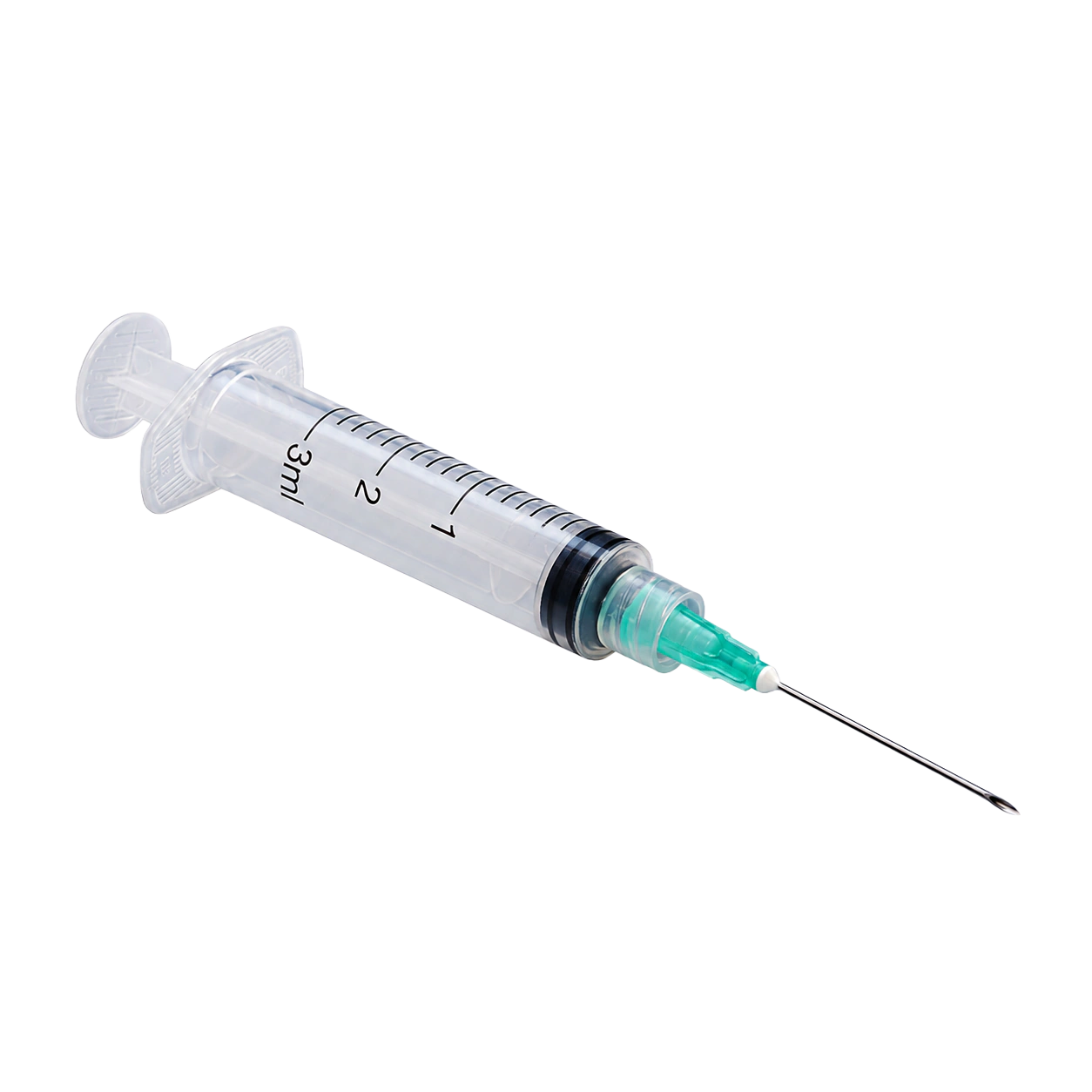
Two kinds of syringe, two jobs
Working with research peptides takes two different syringes. A larger luer-lock syringe moves the diluent from the water vial to the peptide vial, a job where a millilitre or two has to be transferred and a tenth of a millilitre does not matter. A small insulin syringe then measures out exact fractions of the reconstituted solution, a job where a hundredth of a millilitre does matter.
Using one syringe for both is a false economy. A 3 ml syringe cannot read 0.05 ml, and an insulin syringe takes three or four fills to transfer 3 ml of water, puncturing the stoppers every time.
Insulin syringes and the U-100 scale
An insulin syringe is graduated in units rather than millilitres. The U-100 standard sets 100 units to 1 ml, so one unit is 0.01 ml and ten units is 0.1 ml. The units say nothing about the amount of peptide; that is fixed by the concentration chosen at reconstitution; the peptide calculator converts a dose into units. Three sizes share the same scale and differ only in how finely the marks are spaced.
- 1 ml syringe: 100 units, usually marked every 2 units. The all-round choice for solutions of 2 to 5 mg/ml.
- 0.5 ml syringe: 50 units, marked every unit. Easier to read for draws under 25 units.
- 0.3 ml syringe: 30 units, often marked every half unit. For the smallest volumes, where a 1 ml syringe would be read to within a single line.
- The needle is fixed, typically 31G and 6 mm, and the dead space in the hub is close to zero, which is why the whole measured volume is actually delivered.
Luer-lock syringes and needles
A luer-lock syringe has a threaded tip onto which a separate needle screws. The lock stops the needle from being pushed off under pressure, which a plain slip-tip syringe cannot guarantee. The 3 ml size is the workhorse for reconstitution: it draws a whole vial of diluent in one go and its scale, marked every 0.1 ml, is precise enough for setting a concentration.
Because the needle is separate, it can be matched to the job. A 20G or 21G needle draws through a stopper quickly and copes with thicker solutions; a 23G needle, as supplied with the syringe, is a good compromise between speed and a small hole in the stopper. A needle that has been used to draw is swapped for a fresh one before the solution is dispensed, since the first pass through rubber blunts the tip.
Needle gauges
Gauge (G) is the needle's outer diameter on a scale that runs backwards: the higher the number, the thinner the needle. Length is quoted separately in millimetres. Thinner needles draw more slowly and bend more easily, thicker ones leave a bigger hole in the rubber stopper, which is where air and bacteria can get in over the weeks a multi-dose vial is in use.
- 18G to 21G: wide bore. Draws fast, suits viscous solutions and large volumes, leaves a larger hole in the stopper.
- 22G to 25G: medium. The usual range on luer-lock syringes for transferring diluent.
- 27G to 29G: fine. Older insulin syringes and some pen needles; the injection pen guide covers how pen needles are used.
- 30G to 32G: very fine. Current insulin syringes (31G) and pen needles (32G, 4 mm). Slow to draw through, but the smallest puncture.
Syringe filters
A syringe filter is a small disc of membrane in a plastic housing that screws onto a luer-lock syringe. Pushing a solution through a 0.22 µm pore removes bacteria, which is how a solution prepared from non-sterile components is made sterile without heat. The 13 mm size handles the few millilitres involved in peptide work; larger discs waste solution in the housing.
The membrane material matters for peptides. Low-protein-binding membranes such as PES or PVDF let the peptide through; nylon and some cellulose membranes adsorb it and can take a measurable share of a small vial. Filtering also has a cost in volume, since a little solution always stays behind in the housing. For that reason a peptide reconstituted from a sealed vial with sterile diluent is not filtered; the filter is for the exceptions.
Hygiene and disposal
- Open a syringe just before use and never let the needle touch anything but the stopper, wiped with an alcohol pad.
- One syringe, one draw. Do not recap a used needle by hand.
- Used syringes and needles go in a rigid sharps container, never in household waste. Dutch municipalities take sealed sharps containers as small chemical waste (KCA), and many pharmacies accept them.
- Keep used and unused syringes in separate places so they cannot be mixed up.
Frequently asked questions
- What do the units on an insulin syringe mean?
- The units on an insulin syringe are a volume scale, not a measure of peptide. On a U-100 syringe 100 units equals 1 ml, so each unit is 0.01 ml. How much peptide a unit contains depends on the concentration of the solution: at 2.5 mg/ml one unit holds 25 mcg. The peptide calculator converts between the two.
- Can a syringe be used more than once?
- No. A syringe is sterile once, and the needle tip blunts the first time it passes through a rubber stopper. Reusing it introduces bacteria into the vial and makes every later draw less precise. Use a new syringe for every draw and put the used one in a sharps container.
- When is a syringe filter needed?
- Only when the solution was not sterile to begin with, for example a peptide dissolved in a diluent that is not sold as sterile, or a solution that has been combined from several vials on an open bench. A peptide reconstituted with sterile bacteriostatic water from a sealed vial does not need filtering, and every pass through a filter loses a little peptide to the membrane.