
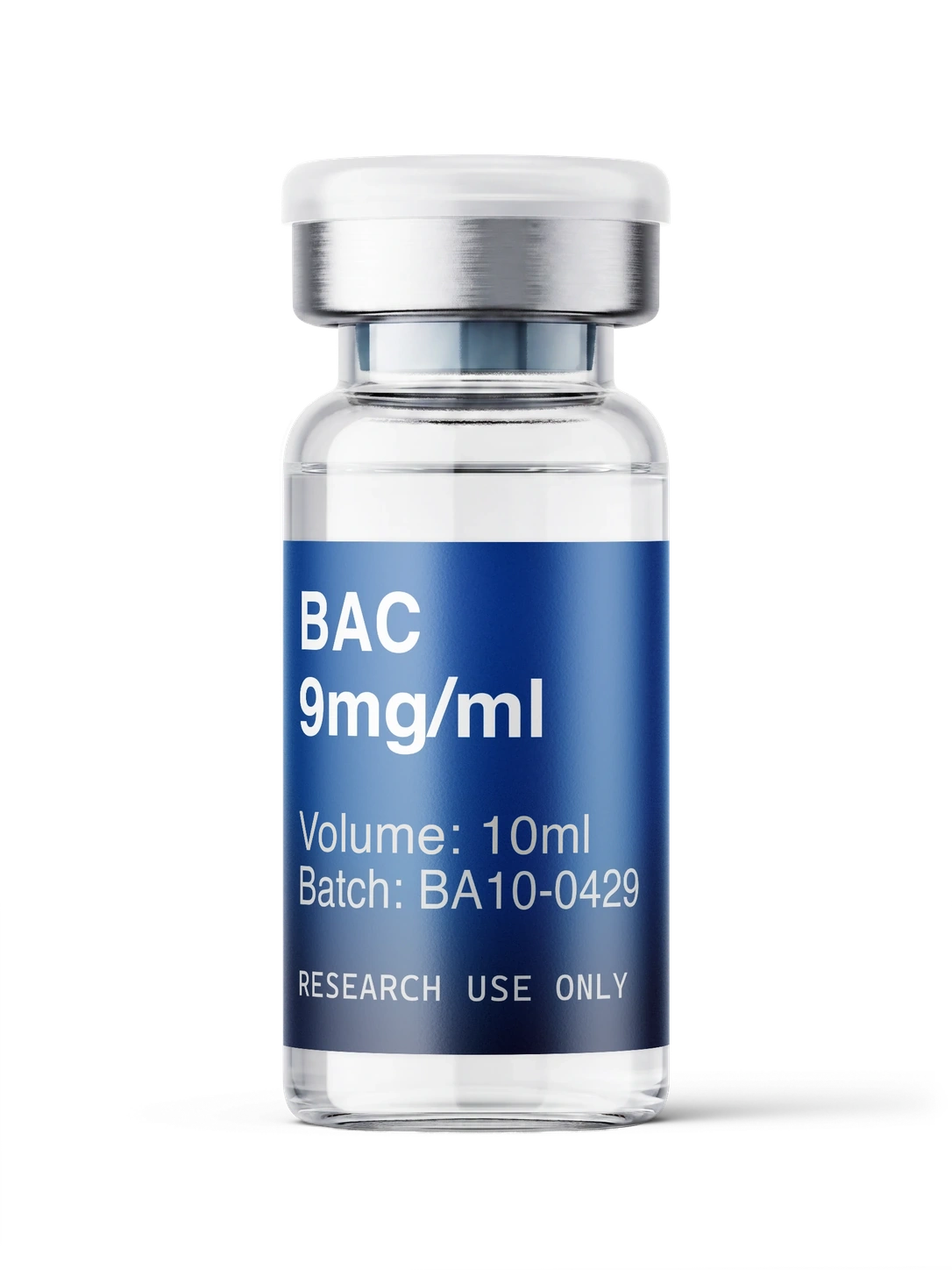
What bacteriostatic water is
Bacteriostatic water (BAC water) is sterile, non-pyrogenic water with 0.9% benzyl alcohol added as a preservative. The benzyl alcohol does not sterilise the water; it stops bacteria from multiplying once the rubber stopper has been punctured. That is what makes it suitable for multi-dose vials, where the same solution is drawn from several times over days or weeks.
Research peptides are shipped freeze-dried (lyophilised) as a dry powder. Before they can be measured out they must be dissolved, and bacteriostatic water is the standard diluent for that step. It is clear, neutral and compatible with nearly every peptide in the catalogue.
Bacteriostatic water versus the alternatives
Several sterile diluents look alike on the shelf, but they are not interchangeable. The diluent comparison covers when each one is the right choice.
- Sterile water for injection: the same water without preservative. Fine for a vial that is used up in one go, but a punctured vial should be discarded afterwards.
- Phosphate buffered saline (PBS): sterile saline buffered to a physiological pH of about 7.4. Used when a protocol asks for an isotonic, buffered solution; it contains no preservative either.
- Acetic acid 0.6%: a mildly acidic diluent for the few peptides that dissolve poorly in neutral water, such as some hydrophobic sequences. Only use it when the peptide's documentation calls for it.
- Tap, distilled or boiled water: never. None of these are sterile or pyrogen-free, and they are not suitable for any laboratory preparation.
How much to use
The amount of water sets the concentration, not the dose. A 5 mg vial dissolved in 1 ml gives 5 mg/ml; the same vial in 2 ml gives 2.5 mg/ml. Lower concentrations are easier to measure precisely on a 1 ml insulin syringe, which is why 2 ml is a common choice for vials of 5 to 10 mg.
The peptide calculator on this site converts vial size, water volume and target amount into syringe units, so the arithmetic does not have to be done by hand.
Storage and shelf life
- Unopened vials: store at room temperature (20 to 25 °C), protected from light. Do not freeze.
- Opened vials: usable for 28 days after the first puncture, the limit the United States Pharmacopeia sets for multi-dose containers. Write the date on the label.
- Reconstituted peptides: keep the peptide vial refrigerated at 2 to 8 °C after adding the water. The preservative protects against bacteria, not against the peptide itself degrading at room temperature.
- Discard any vial that is cloudy, discoloured or contains particles, whatever its date.
Safety notes on benzyl alcohol
Benzyl alcohol is a well-characterised preservative, but it is not inert. Pharmacopeial labels warn that it is unsuitable for neonates and that a small number of people react to it. For laboratory preparation this matters mainly as a reminder that bacteriostatic water is a reagent with its own documentation, and that the batch certificate for benzyl alcohol content is worth checking.
Every batch of bacteriostatic water sold here is tested for benzyl alcohol content, and the certificate is published on the lab results page.
Frequently asked questions
- Is bacteriostatic water the same as sterile water?
- No. Sterile water for injection has no preservative, so a vial is meant to be used once. Bacteriostatic water contains 0.9% benzyl alcohol, which keeps the vial usable for repeated draws over 28 days.
- How much bacteriostatic water do I add to a vial?
- Between 1 and 3 ml per peptide vial is the usual range. More water gives a lower concentration, which makes small doses easier to measure on an insulin syringe. The peptide calculator works out the concentration for any volume.
- How long does an opened vial last?
- Write the date of the first puncture on the vial and discard it 28 days later, even if water is left. Discard it sooner if it turns cloudy or shows particles.