
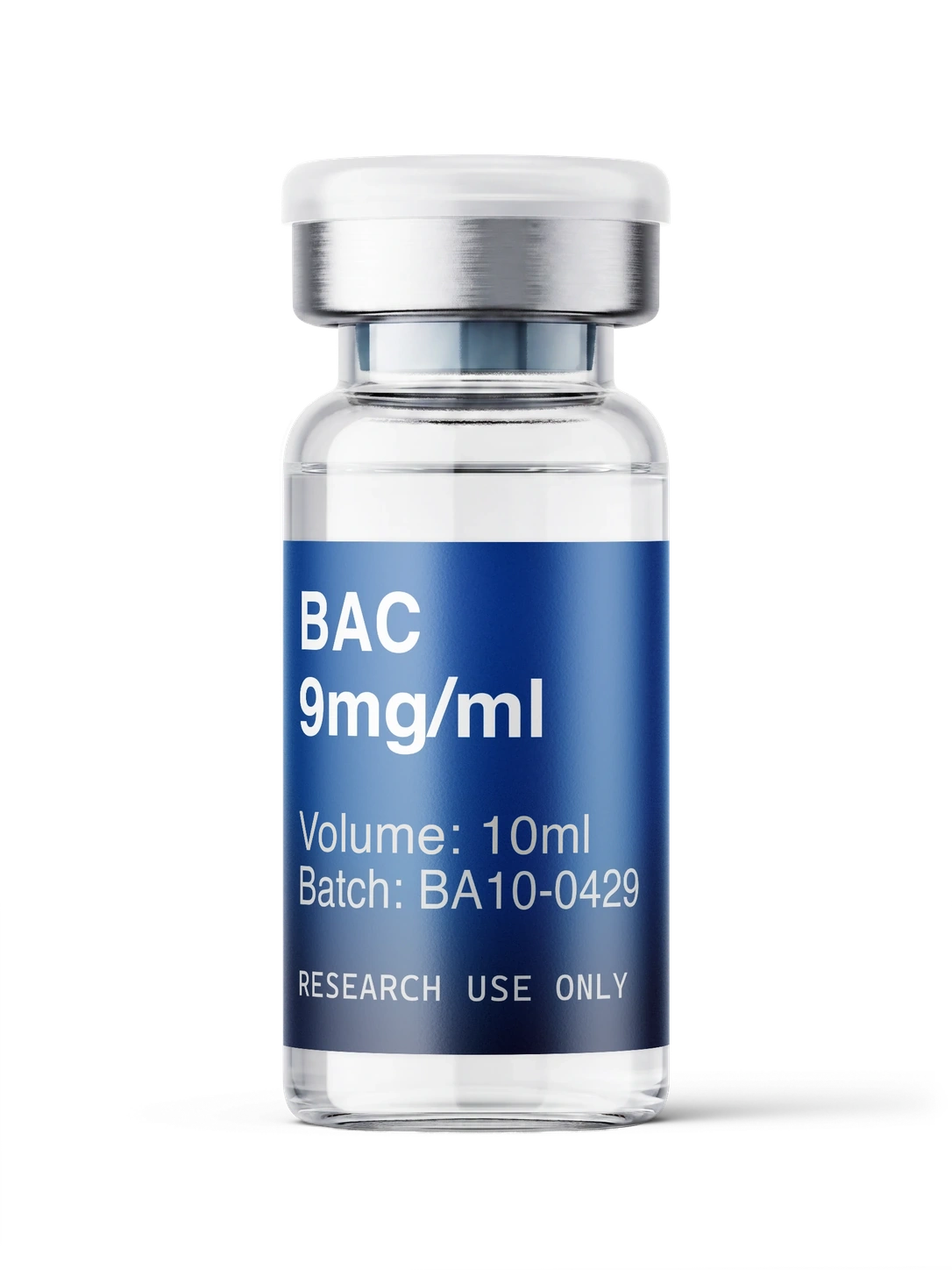
What a diluent has to do
A diluent has three jobs: dissolve the lyophilised peptide completely, keep it in solution without degrading it, and stay free of microbial growth for as long as the vial is in use. No single liquid is best at all three, which is why three sterile diluents sit next to each other in the supplies section. The choice depends on the peptide's chemistry and on how the vial will be used.
All three are sterile, pyrogen-free and supplied in sealed vials with a rubber stopper. What differs is the pH, the salt content and whether there is a preservative.
Bacteriostatic water 0.9%
Sterile water with 0.9% benzyl alcohol as preservative. It is neutral, contains no salts and keeps a punctured vial usable for 28 days, which makes it the default for any peptide that is reconstituted once and drawn from many times. Nearly every peptide in the catalogue dissolves in it without help.
Its limits are the mirror of its strengths. It is not isotonic, so a protocol that calls for an isotonic solution needs PBS instead. And benzyl alcohol, while harmless to most peptides, is documented to cause aggregation of a few larger proteins; where a product's documentation says to avoid it, that documentation wins.
Phosphate buffered saline (PBS)
PBS is sodium chloride plus a sodium phosphate buffer, matched to the osmolarity and pH of body fluids: isotonic and about pH 7.4. It is the standard solvent in cell-culture and assay work, where a solution has to be added to cells or tissue without shocking them osmotically or shifting their pH. Peptides that are sensitive to pH keep their charge state better in a buffer than in plain water.
PBS contains no preservative. Once the stopper is punctured the vial should be used that day and the remainder discarded. It is therefore the diluent for a single preparation, not for a multi-dose vial. Phosphate can also precipitate with some divalent metal ions, which is worth remembering for copper peptides such as GHK-Cu.
Acetic acid 0.6%
A dilute solution of acetic acid in sterile water, mildly acidic at roughly pH 3. Peptides carry charged side chains, and a sequence with a net positive charge, rich in arginine, lysine or histidine, dissolves far more readily when the solution is acidic than at neutral pH. Some hydrophobic sequences behave the same way. For those peptides a cloudy or gel-like result in bacteriostatic water is the sign that an acidic start would have been better.
The usual technique is to dissolve the powder in a small volume of acetic acid first and then bring the vial up to the final volume with bacteriostatic water, so that the solution ends up only slightly acidic and still preserved. Acetic acid on its own has no preservative, and an acidic solution is not what most protocols expect, so it is a solubility aid rather than a general-purpose diluent.
Choosing in practice
A short decision list covers almost every case.
- Multi-dose vial, peptide dissolves clear in neutral water: bacteriostatic water. This covers most of the catalogue.
- Protocol asks for an isotonic or buffered solution, prepared and used the same day: PBS.
- Peptide stays cloudy in neutral water, or its documentation names an acidic diluent: dissolve in a little acetic acid, then dilute with bacteriostatic water.
- Product documentation warns against benzyl alcohol: sterile water for injection or PBS, used as a single-dose preparation.
- Whatever the choice, write the diluent on the label along with the date and concentration; the reconstitution guide has the steps.
What never to use
Tap water, bottled water, distilled water from a shop and boiled water are not sterile, not pyrogen-free and of unknown pH and mineral content. None of them belongs in a laboratory preparation. The same goes for diluents from an opened vial of unknown age, and for any vial whose contents are cloudy or discoloured. Sterile diluents cost a few euros per vial; the peptide they are added to costs considerably more.
Frequently asked questions
- Can every peptide be reconstituted in bacteriostatic water?
- Yes, for nearly all of them. Bacteriostatic water is neutral, sterile and preserved, and the peptides in the catalogue are supplied as salts that dissolve readily in it. The exceptions are the few sequences that stay cloudy in neutral water and are better started in acetic acid, and any protocol that specifically asks for a buffered, isotonic solution.
- What is the difference between PBS and sterile saline?
- Sterile saline is 0.9% sodium chloride in water, with no buffer and usually no preservative. PBS adds a phosphate buffer that holds the pH at about 7.4. Both are isotonic; only PBS resists pH changes. Neither keeps once the stopper has been punctured, so both are single-use diluents.
- Can diluents be mixed?
- They can be, but there is rarely a reason to. A peptide that needs acetic acid to dissolve is usually dissolved in a small volume of it first and then diluted with bacteriostatic water, so that the final solution is only mildly acidic and still preserved. Mixing diluents without such a reason only makes the result harder to describe on the label.