
Why storage matters
A peptide is a chain of amino acids held in a particular shape, and three things slowly take it apart: water, heat and light. Water lets the chain hydrolyse and lets certain residues deamidate or oxidise; heat speeds every one of those reactions up; ultraviolet light attacks tryptophan, tyrosine and the sulphur in methionine and cysteine. Good storage is nothing more than keeping all three away from the vial.
Freeze-drying removes the water, which is why a lyophilised vial keeps for years while the same peptide in solution keeps for weeks. The two forms therefore have different rules, and the moment of reconstitution is the moment the rules change.
Lyophilised peptides
Dry powder is the robust form. Cold, dark and dry covers nearly everything.
- Long-term storage: the freezer at -20 °C, in the original box. Suppliers generally quote several years for a sealed vial kept this way.
- Vials in regular use: the fridge at 2 to 8 °C is fine for months and avoids pulling vials in and out of the freezer.
- Keep the vials dry. The rubber stopper is airtight, but a vial that has been punctured for a partial draw is no longer sealed and should be reconstituted rather than put back.
- Let a cold vial reach room temperature before opening it, which takes 10 to 15 minutes. Opening it cold draws condensation onto the powder.
- Keep the box closed or the vials in an opaque container. Clear glass offers no protection from light.
Reconstituted peptides
Once water is in the vial the peptide is back in the environment it degrades in, so the margins become days and weeks instead of years.
- Refrigerate at 2 to 8 °C straight after reconstitution and keep the vial there between draws.
- Reconstituted in bacteriostatic water, a vial stays usable for about four weeks. The benzyl alcohol holds bacteria back; it does nothing to slow the chemistry, so the four weeks is a stability limit as much as a hygiene limit.
- Reconstituted in sterile water or PBS without preservative, treat the vial as single-use and discard what is not used the same day.
- Do not freeze a reconstituted multi-dose vial, and do not leave it at room temperature for more than the minutes it takes to draw from it.
- Some peptides are known to be less stable in solution than the rule of thumb; where the product page or certificate says so, follow the shorter limit.
Freeze-thaw cycles
Freezing a solution is not gentle. As ice forms, the remaining liquid becomes more and more concentrated in peptide and salts, the pH can shift, and the ice crystals themselves shear the molecules. Thawing reverses the physics but not the damage, and the next cycle adds to it. Laboratories that freeze peptide solutions therefore split them into single-use aliquots so that each portion is frozen once and thawed once.
For a multi-dose vial the same logic says: keep it in the fridge, and if a freezer is involved at all it is for the dry powder before reconstitution.
Travelling with peptides
- Lyophilised vials: a few days at room temperature in a closed box does no measurable harm. Avoid a hot car or direct sun.
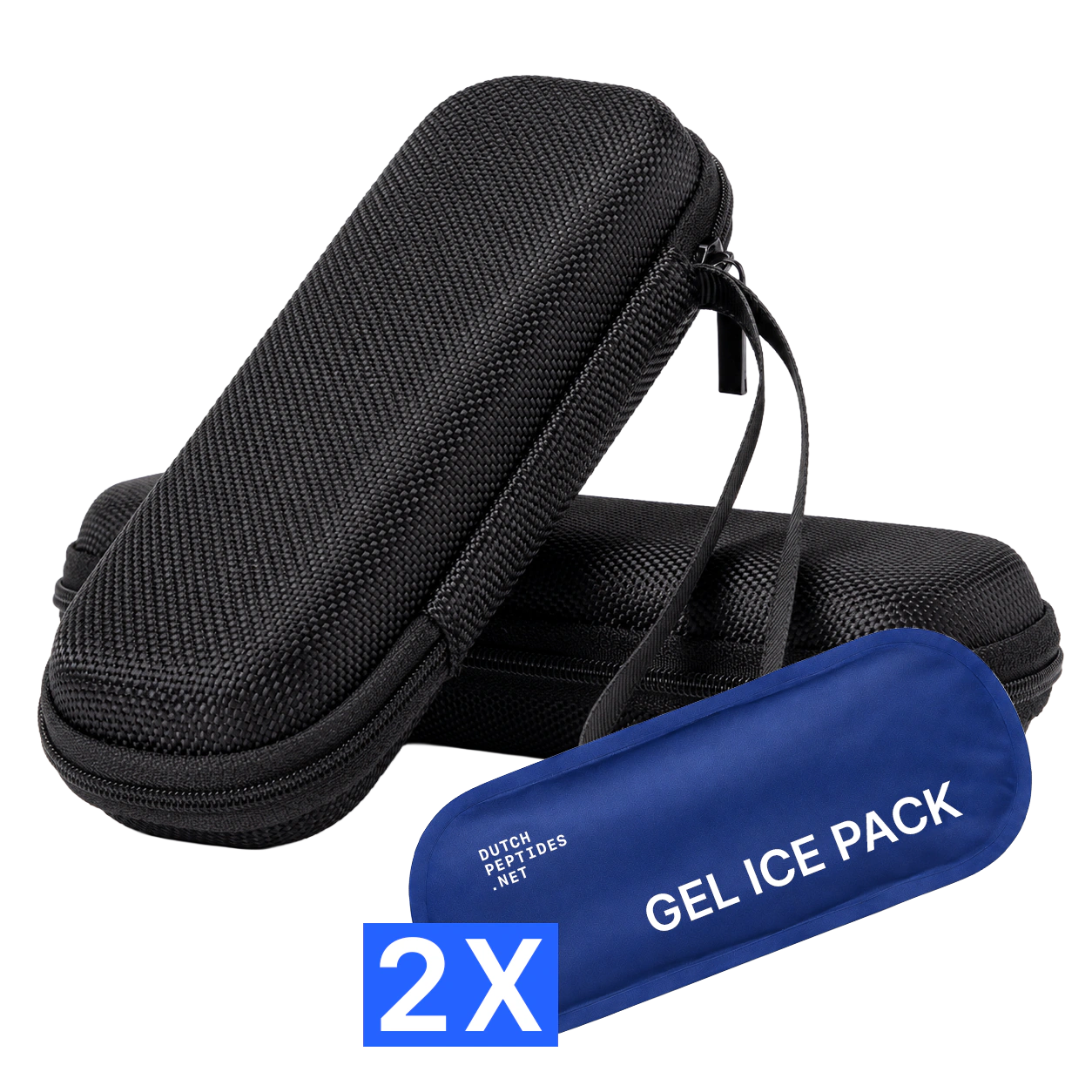
- Reconstituted vials: carry them in an insulated case with a frozen gel pack, with a layer of cloth between the pack and the vials so they chill without freezing.
- Hand luggage, not the hold. Hold temperatures can drop below freezing and the bag may be lost.
- Carry the vials in their original labelled packaging together with the order confirmation, so the research-use-only labelling and the contents are clear to anyone who inspects them.
- On arrival, put reconstituted vials back in a fridge within a day and lyophilised vials in a fridge or freezer.
Frequently asked questions
- The vials arrived at room temperature. Are they still good?
- Yes. Shipping takes days, not months, and a freeze-dried peptide loses very little in that time. The clock that matters starts when the vial is reconstituted. Put the vials in the fridge or freezer when they arrive and let a vial reach room temperature before opening it.
- Can a reconstituted vial go in the freezer?
- Not a multi-dose vial. Ice crystals and the concentration changes during freezing can unfold or aggregate the peptide, and every thaw repeats the damage. Freezing is a laboratory option only for single-use aliquots in a diluent without preservative, frozen once and thawed once.
- How can I tell a peptide has gone off?
- A clear solution that has turned cloudy, yellow or shows particles has degraded or been contaminated and should be discarded. Loss of activity without visible change cannot be seen by eye; that is what the dates on the label and the storage rules above are for.