
Why peptides need reconstituting
Peptides are fragile molecules. To survive shipping and storage they are freeze-dried into a small cake of powder at the bottom of the vial, which is stable for months when kept cool and dry. Reconstitution is simply the step of dissolving that powder in a sterile diluent so that an exact amount can be measured with a syringe.
The process is the same for nearly every lyophilised peptide. What changes is the amount of diluent, which sets the final concentration.
What you need
The injection kit bundles the syringes, needles and alcohol wipes for the first two vials; the syringes and needles guide explains what each one is for.
- The lyophilised peptide vial, taken out of the fridge 10 to 15 minutes beforehand so it reaches room temperature.
- Bacteriostatic water 0.9%, the usual diluent for multi-dose vials.
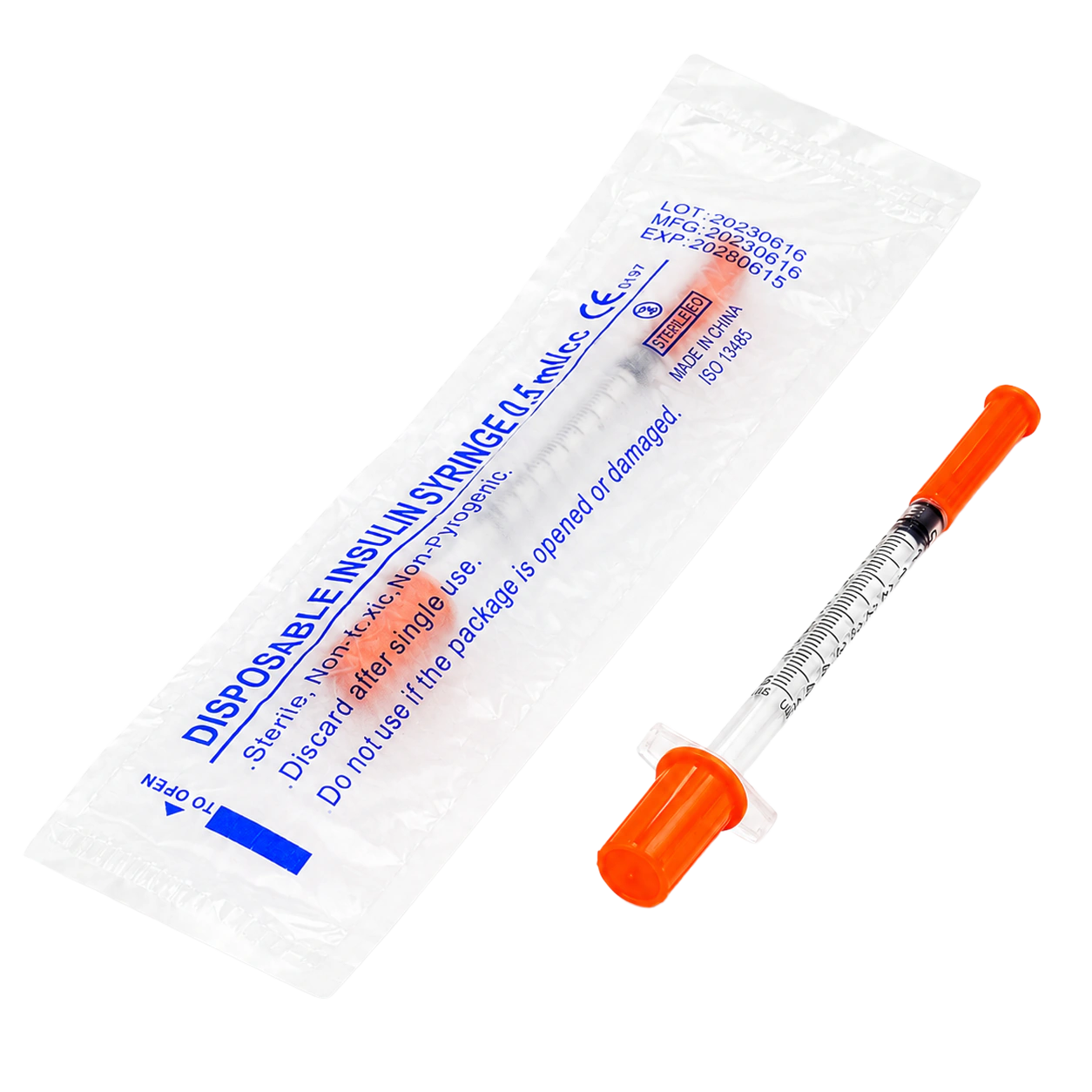
- One syringe to transfer the water (a 3 ml luer-lock syringe for larger volumes) and 1 ml insulin syringes for measuring out.
- Alcohol pads for the stoppers and a clean, dry work surface.
- A pen to write the date and concentration on the vial.
Step by step
- Wash your hands and wipe the rubber stoppers of both vials with an alcohol pad. Let them dry.
- Draw the chosen volume of bacteriostatic water into the syringe, for example 2 ml for a 5 mg vial.
- Push the needle through the peptide vial's stopper and point it at the glass wall, not the powder.
- Release the water slowly so it runs down the inside of the vial. The vacuum in the vial will help pull the plunger.
- Withdraw the needle and let the vial stand. Swirl gently between thumb and finger if needed; never shake it.
- Wait until the solution is completely clear, usually within a few minutes.
- Label the vial with the date and the concentration (for example 2.5 mg/ml) and put it in the fridge.
Working out the concentration
Concentration is the amount of peptide divided by the amount of water. A 5 mg vial in 2 ml holds 2.5 mg/ml, or 2,500 mcg/ml. On a 1 ml insulin syringe with 100 unit marks, each unit is 0.01 ml, so 10 units of that solution contains 250 mcg.
The peptide calculator does this for any vial size and volume, and shows the result in syringe units.
Common mistakes
- Spraying the water directly onto the powder, which foams and can damage the peptide.
- Shaking the vial to speed up dissolving.
- Reconstituting a vial straight from the fridge, which causes condensation and makes the powder harder to dissolve.
- Forgetting to write the date and concentration on the vial.
- Freezing a reconstituted vial, or leaving it at room temperature for days.
- Reusing a bacteriostatic water vial more than 28 days after it was first punctured.
Frequently asked questions
- Why should the vial not be shaken?
- Shaking creates foam and shear forces that can unfold the peptide. Swirl the vial gently or let it stand; most peptides dissolve within a few minutes on their own.
- The solution looks cloudy. Is that normal?
- A few small, slowly dissolving flecks are normal in the first minutes. Persistent cloudiness or particles after gentle swirling mean the solution should not be used.
- How long does a reconstituted peptide keep?
- Stability varies by peptide, but as a rule of thumb a reconstituted vial kept at 2 to 8 °C and protected from light stays usable for about four weeks. Do not freeze it once water has been added.