
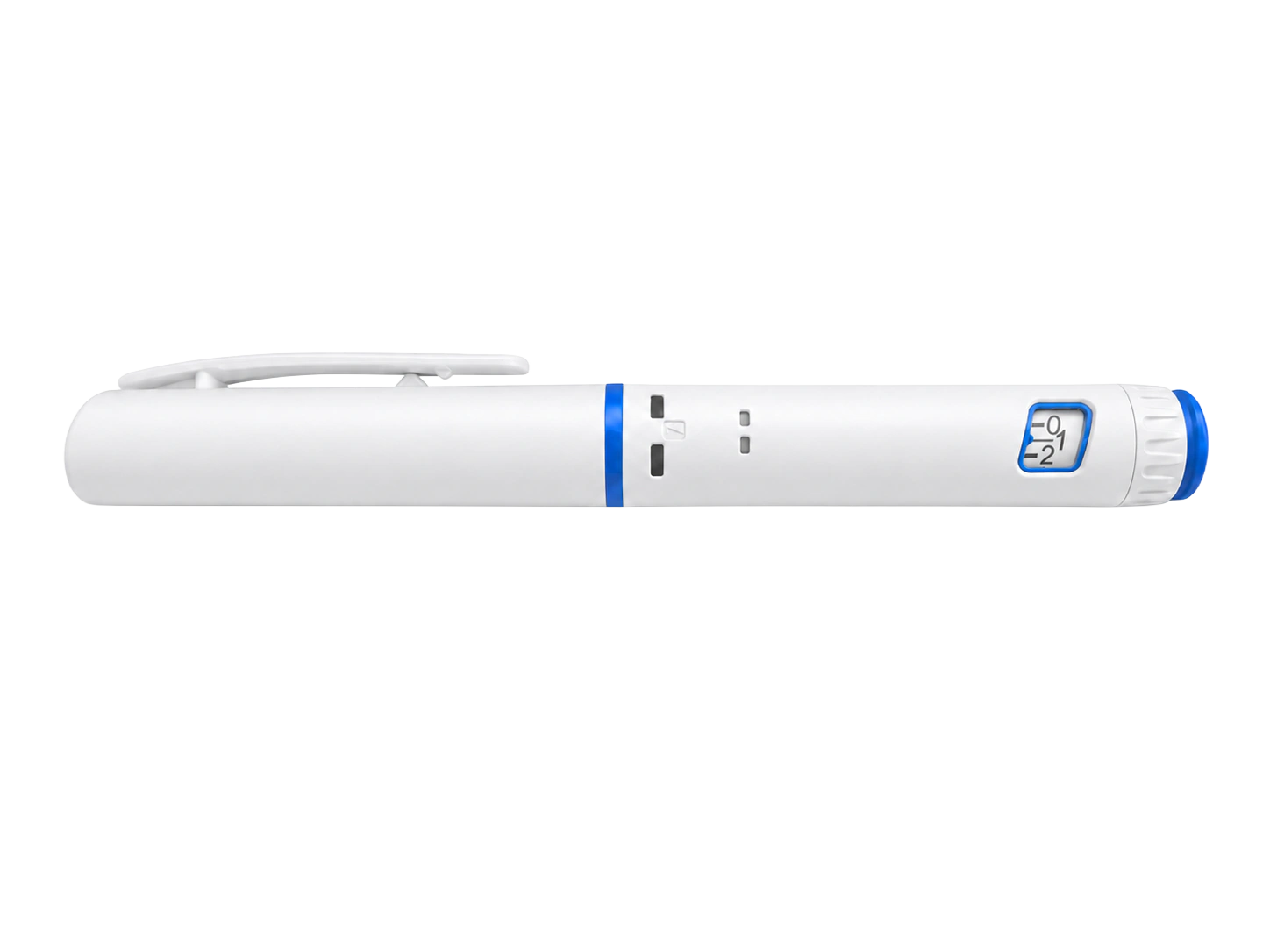
What a pre-filled pen is
A pre-filled pen is the same pen as the reusable pen V2 with the same 3 ml cartridge and the same 32G pen needles. The difference is that the work has been done here: the peptide vial is reconstituted, the solution is drawn into the cartridge, the cartridge is locked into the pen and the pen is primed. It arrives cooled, with 10 pen needles and 10 alcohol wipes, ready for the first dose.
Once assembled the pen is sealed. The plunger cannot be pushed back and the cartridge holder is not meant to come off again, so the pen holds one strength and is discarded when it is empty. The Semaglutide, Tirzepatide, Retatrutide and GHK-Cu pens are each sold per strength. To fill and refill a pen yourself, the injection pen guide covers the reusable pen and cartridges.
When it arrives
The pen is shipped cooled, and the first thing to do is to keep it that way.
- Put the pen in the fridge at 2 to 8 °C straight away, in its box and without a needle on it. Do not freeze it.
- Check the label: it names the peptide, the strength and the concentration, and the fill date sets the 28 day clock. Two pens of different strengths look alike, so keep the label on.
- Look at the solution through the window. It should be clear; a GHK-Cu pen is clear and blue. Cloudiness or particles mean the pen should not be used.
- Keep the needles and wipes with the pen. Ten needles cover ten injections, and more pen needles are sold separately.
Units and concentration
The pen counts in units, and one unit is 0.01 ml, the same scale as an insulin syringe. The cartridge can take 3 ml, but a pen holds the amount of peptide on the label dissolved in the water the vial was reconstituted in, with the air pushed out when it was primed. So the volume differs from pen to pen, and the figure that matters is the concentration on the label, in mg/ml. From that, the arithmetic is the same as for a syringe, and the peptide calculator does it for any dose.
- Units for 1 mg: 100 divided by the concentration. At 5 mg/ml that is 20 units; at 2.5 mg/ml, 40 units; at 10 mg/ml, 10 units.
- Units for a dose: the dose in mg divided by the concentration, times 100. A 0.25 mg dose at 5 mg/ml is 5 units; a 2 mg dose at 10 mg/ml is 20 units.
- Doses per pen: the milligrams on the label divided by the dose. A 10 mg pen gives forty doses of 0.25 mg or ten of 1 mg, less the small amount used for flow checks.
Giving a dose
- Take the pen out of the fridge a few minutes beforehand and wipe the rubber septum at the front, where the needle goes, with an alcohol wipe.
- Screw a new pen needle on, pull off both caps, and keep the outer cap for taking the needle off later.
- Flow check: dial 2 units and press the button with the needle pointing up until a drop appears at the tip. Repeat if no drop shows. This clears the air in the new needle.
- Dial the dose in units. The dose window shows the number; the pen will not dial past what is left in the cartridge.
- Inject, then hold the button down for a slow count of ten after the dial has returned to zero before withdrawing, so the full dose leaves the needle.
- Unscrew the needle using its outer cap, drop it in a sharps container, cap the pen and put it back in the fridge.
Storage and travel
A pre-filled pen is stored like any reconstituted peptide: in the fridge at 2 to 8 °C, out of the light, with the needle removed, and used within 28 days of the fill date on the label. Never freeze it, and do not leave it at room temperature longer than an injection takes. The storage guide explains why the clock starts at reconstitution.
For a day out or a trip, the insulated pen case with its two gel ice packs keeps the pen cool between fridges. Freeze the packs, not the pen, and keep a layer of cloth between them so the solution does not freeze.
The GHK-Cu pen
The GHK-Cu pen works like the others, with three things worth knowing.
- The solution is blue. The colour comes from the copper ion held by the peptide, and a clear blue is the normal look. A pen whose colour has faded, or whose solution has turned cloudy, should be discarded.
- Keep it in the box. The copper complex is more sensitive to light than most peptides, so the pen stays in its box in the fridge between doses.
- The amounts are larger, so a dose is more milligrams and the concentration on the label is higher than on the other pens. Work the units out from that label, not from a GLP-1 pen, before dialing.
Common mistakes
- Trying to open the pen or push the plunger back to refill it.
- Skipping the 2 unit flow check after screwing on a new needle.
- Leaving a needle on the pen between injections, which lets air in and solution out.
- Leaving the pen on the counter or in a bag at room temperature.
- Using a pen past 28 days from its fill date.
- Mixing up two pens of different strengths, and dialing the units for the wrong one.
Frequently asked questions
- Can I refill the pen or change the cartridge?
- No. Once the cartridge is locked into the pen the plunger cannot be pushed back and the holder is not meant to come off again. When the pen is empty, take the needle off and put the whole pen in a sharps container. For a pen that takes a new cartridge each time, use the reusable pen V2 and the injection pen guide.
- Do I still need to prime it?
- The pen is primed before it ships, so the first dose is not lost to air in the cartridge. A new needle still holds a little air, so do a 2 unit flow check every time a needle is screwed on, as with any pen, until a drop shows at the tip.
- How many units is one milligram?
- That depends on the concentration on the label, in mg/ml, because the pen holds the vial's amount in the water it was reconstituted in. Divide 100 by the concentration to get the units for 1 mg: at 5 mg/ml, 1 mg is 20 units and 0.5 mg is 10 units. The units section below shows the arithmetic, and the peptide calculator does it for any dose.
- The GHK-Cu pen is blue. Is that normal?
- Yes. The blue comes from the copper bound to the peptide, and a clear blue solution is what an intact GHK-Cu pen looks like. Discard it if the colour fades, or if the solution turns cloudy or shows particles.