
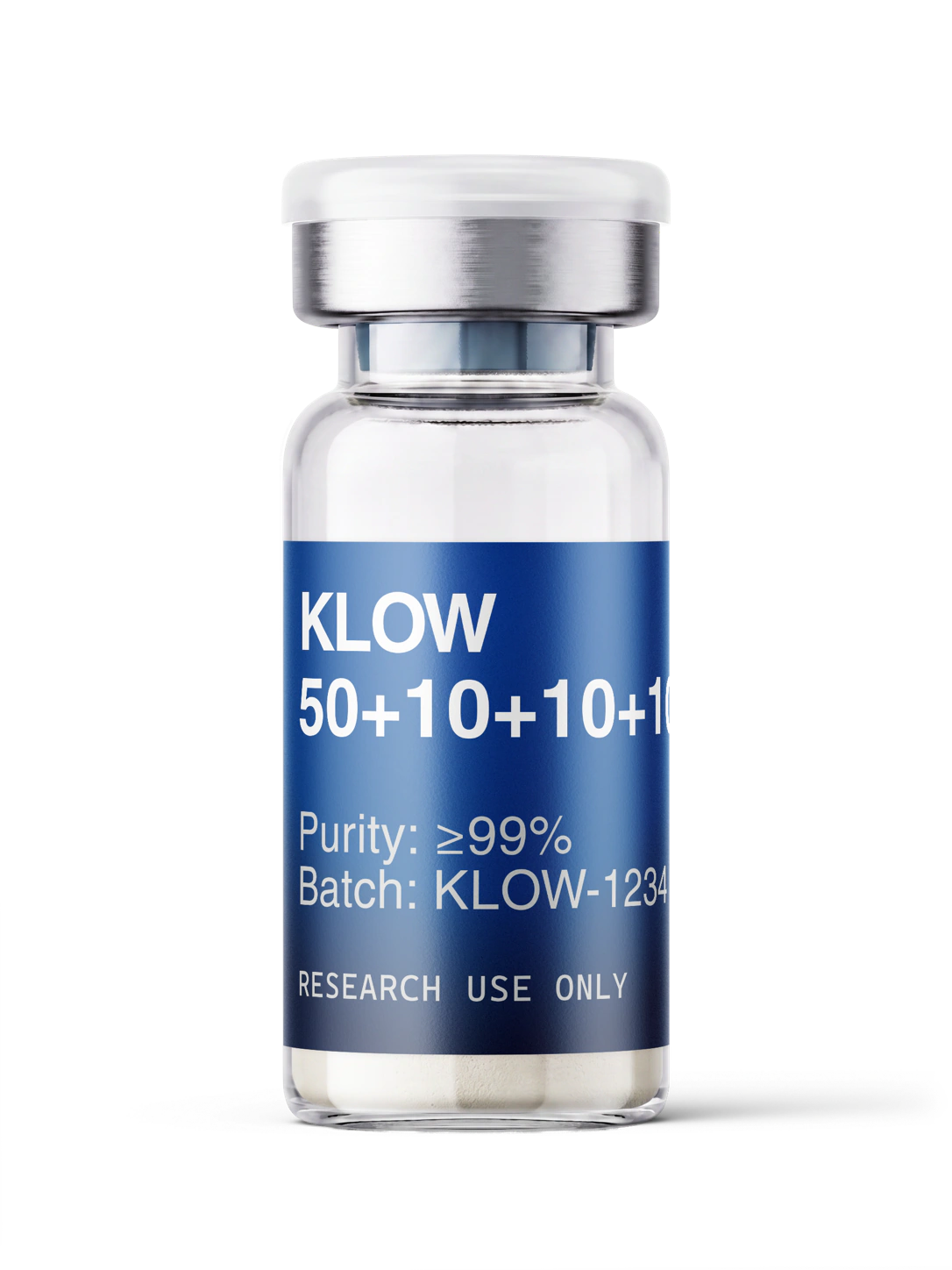
What is KLOW Stack?
KLOW is a blend of four unrelated peptides in one vial: GHK-Cu, BPC-157, TB-500 and KPV. The blend itself has never been studied, in animals or in people. KPV and the TB-500 fragment have never been given to people, and GHK-Cu has only been tested on human skin. None of the four is an authorised medicine in the EU or the US, and sport bans the blend at all times.
At a glance
- What it is
- Blend of GHK-Cu, BPC-157, TB-500 and KPV; ours is one 80 mg vial (50/10/10/10 mg)
- Status in the EU
- None of the four is an authorised medicine; we sell the blend as research material
- Status in the US
- Not FDA-approved; advisers backed compounding BPC-157, TB-500 and KPV in July 2026; no decision
- Research
- Blend never studied; parts mostly cell and animal data, GHK-Cu tested in people only on skin
- Sport
- Prohibited at all times: WADA names BPC-157 (S0) and TB-500 (S2.3)
- Human evidence
- Animal data only: no study of the blend; two of its parts never given to people
KLOW Stack dosage snapshot
- Route
- subQ
- Dose range
- 2.4-4 mg blend
- Frequency
- daily
- Duration
- 4-12 weeks
Based on reported research sources; not a dosing instruction.
Composition and origin
KLOW is not a molecule but a mixture of four peptides that are chemically unrelated. Our KLOW Stack is a single vial holding 80 mg in total: 50 mg of GHK-Cu and 10 mg each of BPC-157, TB-500 and KPV, so by weight GHK-Cu makes up five-eighths of the contents. It is our GLOW blend, with the same 50, 10 and 10 mg of GHK-Cu, BPC-157 and TB-500, plus 10 mg of KPV, and it contains both peptides of the pair sold as Wolverine.
The four parts have separate histories. GHK-Cu is the tripeptide glycine-histidine-lysine bound to copper; Loren Pickart found it in human blood plasma in 1973, in experiments on liver cells. BPC-157 is a synthetic chain of 15 amino acids based on a gastric-juice protein, first made at the University of Zagreb and described in 1993. TB-500 is a common name rather than an official one: the FDA uses it for Ac-LKKTETQ, a seven-amino-acid fragment (residues 17 to 23) of thymosin beta-4 with an acetyl group added, while some sellers use it for the full 43-amino-acid protein. KPV is lysine-proline-valine, a fragment of the hormone alpha-MSH.
The combination comes from vendors and online forums, not from research: we found no published or registered study of it. The FDA's 2026 reviews describe the same habit of mixing. Websites sell BPC-157 and TB-500 together as injections and nasal sprays, and promote KPV in a 'regenerative combo' with BPC-157, TB-500, AOD-9604 and follistatin-344.
How it is thought to work
GHK binds copper, and the copper complex is thought to act as a local signal for tissue repair. In cell cultures and animal wound models GHK-Cu increased the production of collagen, elastin and glycosaminoglycans, the building blocks of connective tissue. Pickart puts the GHK concentration in the blood plasma of 20-year-olds at about 200 ng/mL, against about 80 ng/mL in 60-year-olds.
BPC-157 has no identified molecular target. Animal and cell studies link it to blood-vessel growth, nitric oxide production and lower levels of inflammatory signals, mostly in models of gut and tissue injury.
Thymosin beta-4 binds actin, the protein that shapes cells and lets them move, and has been studied for wound repair. The TB-500 fragment contains its actin-binding region, but whether the fragment alone carries those effects is not established: in the one cell experiment the FDA cites, it did not speed the closure of scratch wounds, and the FDA notes that its effect on wound healing in living animals is unknown.
KPV does not appear to work through the melanocortin receptors that alpha-MSH uses: in laboratory tests it did not displace alpha-MSH from its binding sites. The peptide transporter PepT1 has been proposed as its way into gut and immune cells, but the FDA concluded in 2026 that its molecular target remains unknown.
The argument for putting the four together is that they act on different pathways and might add up: skin (GHK-Cu), tissue repair (BPC-157 and TB-500) and inflammation (KPV). That is a hypothesis. No one has tested whether the effects add up, cancel out or interact, and the only controlled experiment with two of the four, BPC-157 and TB-500 in rats, found no added effect.
Is KLOW approved?
No. None of the four peptides is an authorised medicine in the EU, the Netherlands or the US, and no medicine combines them. Because none is a registered medicine, KLOW may not be sold or advertised in the Netherlands as a medicine for people; our shop sells it as research material only. GHK-Cu is also widely used in skin and hair cosmetics, a separate legal category that does not cover a vial for injection.
In the United States the debate is about pharmacies compounding the parts. On 29 September 2023 the FDA placed BPC-157, KPV, the TB-500 fragment and GHK-Cu for injection in Category 2 of its interim policy for nominated bulk substances, the group that may present significant safety risks; for injectable GHK-Cu it cited possible immune reactions and limited human data. The nominations were later withdrawn, and the FDA went on to review BPC-157, TB-500 and KPV on its own initiative. On 23 July 2026 its Pharmacy Compounding Advisory Committee voted 8 to 6, with one abstention, to recommend adding those three to the list of substances pharmacies may compound, against the advice of FDA staff. The vote is advice only, and no FDA decision had been published by 28 October 2026.
GHK-Cu was not part of that vote. Its nominations were withdrawn in April 2026, but one nominator then kept its request for non-injectable forms, which went back under evaluation in May 2026; the FDA intends to consult the advisory committee about it before the end of February 2027. That review concerns non-injectable GHK-Cu only.
In sport KLOW is prohibited at all times. WADA names BPC-157 under S0, non-approved substances, and thymosin beta-4 and its derivatives such as TB-500 under S2.3, growth factors. GHK-Cu and KPV are not named, but as substances without approval for human therapeutic use they fall under S0, and the 2027 list, in force from 1 January 2027, names peptides in general in that class. In the Netherlands the Dopingautoriteit applies the same list.
What the research shows
Nothing has been published on KLOW itself. Searches of Europe PMC and ClinicalTrials.gov on 28 October 2026 found no study, published or registered, of the blend or of any combination that includes GHK-Cu or KPV. What exists concerns one pair of its parts, and each part on its own:
- BPC-157 with TB-500 in rats (Biçer et al., 2026): 32 rats with a cut and repaired Achilles tendon, 8 per group, received daily injections into the abdominal cavity for four weeks. Only the TB-500 group had significantly stronger tendons than controls, and the combination gave no added benefit over either peptide alone.
- BPC-157 with thymosin beta-4 in people (Lee and Padgett, 2021): in a retrospective chart review at a Florida clinic, 4 of the 16 knee-pain patients reached by phone had received knee injections of both peptides, and 3 of those 4 reported significant relief. There was no control group and no standard outcome measure.
- GHK-Cu: in a multicentre, randomised, evaluator-blinded trial in diabetic foot ulcers (Mulder et al., 1994), a GHK-Cu gel closed a median 98.5% of the area of plantar ulcers against 60.8% with the vehicle gel, and ulcers treated straight after debridement became infected less often (7% against 34%); the abstract does not give the number of patients. Cosmetic studies, such as 12-week tests of a face cream in 71 women and an eye cream in 41 women, are known from a 2002 congress presentation, an unpublished university report and a book chapter; we found no full peer-reviewed paper reporting them. No published trial has given GHK-Cu by injection.
- BPC-157: the FDA's 2026 review found five small human studies. The only placebo-controlled test of effect, an enema trial in 53 people with ulcerative colitis, published only as a conference abstract, found no significant difference. The rest of the evidence is animal and cell work.
- TB-500: the FDA found no clinical study and no human exposure data for the seven-amino-acid fragment by any route. Full-length thymosin beta-4 has been tested as 0.1% eye drops: in the SEER-1 phase 3 trial in neurotrophic keratopathy, 6 of 10 patients healed completely at four weeks against 1 of 8 on placebo (p = 0.0656), short of statistical significance.
- KPV: the FDA found no study in which KPV was given to a person, by any route. Its evidence consists of cell studies, including in human gut-lining cells, and rodent models of inflammation and wound healing.
- Mixed products in practice: an FDA adverse-event report describes a 40-year-old woman who developed diffuse darkening of the skin and gums after a week of injecting a research-labelled BPC-157 and TB-500 product twice daily; it came back when she restarted and stopped when she quit. Two further reports about blended TB-500 and BPC-157 contained no safety assessment.
Safety and the naming problem
No human safety data exist for KLOW. For two of its parts there are none at all: the FDA found no human exposure data for KPV or for the TB-500 fragment. GHK-Cu has been tested in people only on the skin, and the five human studies of BPC-157 were small and short and gave it by enema, by injection into a joint or the bladder wall, or by infusion, never under the skin.
For injected BPC-157, the TB-500 fragment and GHK-Cu alike, the FDA flags a possible risk of immune reactions, linked to aggregation and peptide-related impurities. In the adverse-event report described above, the product held two peptides, so the FDA could not say which one caused the reaction. No study has looked at whether four peptides stay intact in one vial or affect each other there.
The name TB-500 adds uncertainty. It can mean the seven-amino-acid fragment or the 43-amino-acid protein, two molecules of very different size, so 10 mg of one is not the same amount of substance as 10 mg of the other, and the FDA calls such inconsistent naming a safety risk in itself. Our separate TB-500 product is listed as thymosin beta-4 acetate. For a blend of four peptides, only a certificate of analysis that identifies and measures each component can show what a batch contains.
Potential benefits
- Achilles tendon repair with BPC-157 plus TB-500 (rats, no added effect)
- Diabetic foot ulcer healing (GHK-Cu gel, one trial)
- Skin appearance (GHK-Cu creams, small studies)
- Inflammation and wound models (KPV, animals)
- The four-peptide blend: never studied
Safety profile
Unknown risk- CautionNo human safety data exist for the blend; the FDA found none at all for KPV or the TB-500 fragment, and GHK-Cu has been tested in people only on the skin.
- CautionOne FDA adverse-event report describes darkening of the skin and gums after a week of injecting a BPC-157 and TB-500 product; it returned on restarting and stopped after quitting.
- CautionThe FDA warns that injected BPC-157, TB-500 and GHK-Cu may provoke immune reactions, linked to aggregation and peptide-related impurities; this has not been tested in people.
- CautionTB-500 can mean two different molecules, and no study has checked whether four peptides stay intact together in one vial.
Frequently asked questions
- What is in KLOW?
- Four peptides: GHK-Cu, BPC-157, TB-500 and KPV. Our vial holds 80 mg in total, 50 mg of GHK-Cu and 10 mg of each of the others. The ratio comes from vendor practice, not from any study, and the name TB-500 can stand for a seven-amino-acid fragment of thymosin beta-4 or for the full protein.
- Is KLOW legal in the Netherlands?
- None of its four peptides is a registered medicine, so KLOW may not be sold, advertised or supplied as a medicine for people. Buying and selling it as research material is a different status, which our guide on research-use-only products in the Netherlands explains. For athletes it is on the doping list either way.
- Is KLOW banned in sport?
- Yes, at all times, in and out of competition. WADA names BPC-157 under S0 and thymosin beta-4 and its derivatives, TB-500 among them, under S2.3; GHK-Cu and KPV fall under S0 as substances without approval for human therapeutic use, and the 2027 list names peptides in general in that class. In the Netherlands the Dopingautoriteit applies the same list.
- Has KLOW been tested in humans?
- No. No study has given the four peptides together to people or to animals. The closest human record is 4 knee-pain patients who received BPC-157 with thymosin beta-4 in an uncontrolled chart review. On their own, GHK-Cu has been tested on human skin and BPC-157 in five small studies; KPV and the TB-500 fragment never.
- What is the difference between KLOW and GLOW?
- KPV. Our GLOW holds 50 mg of GHK-Cu and 10 mg each of BPC-157 and TB-500; KLOW adds 10 mg of KPV. KPV has been studied only in cells and animals, for inflammation and wound healing, and has never been given to a person, so what it adds to the mix is unknown.
Storage and handling
Store according to product-label instructions and batch handling notes. Lyophilized research peptides are commonly kept dry, protected from light, and handled with clean laboratory technique.
References
Checked against these sources on 28 October 2026.